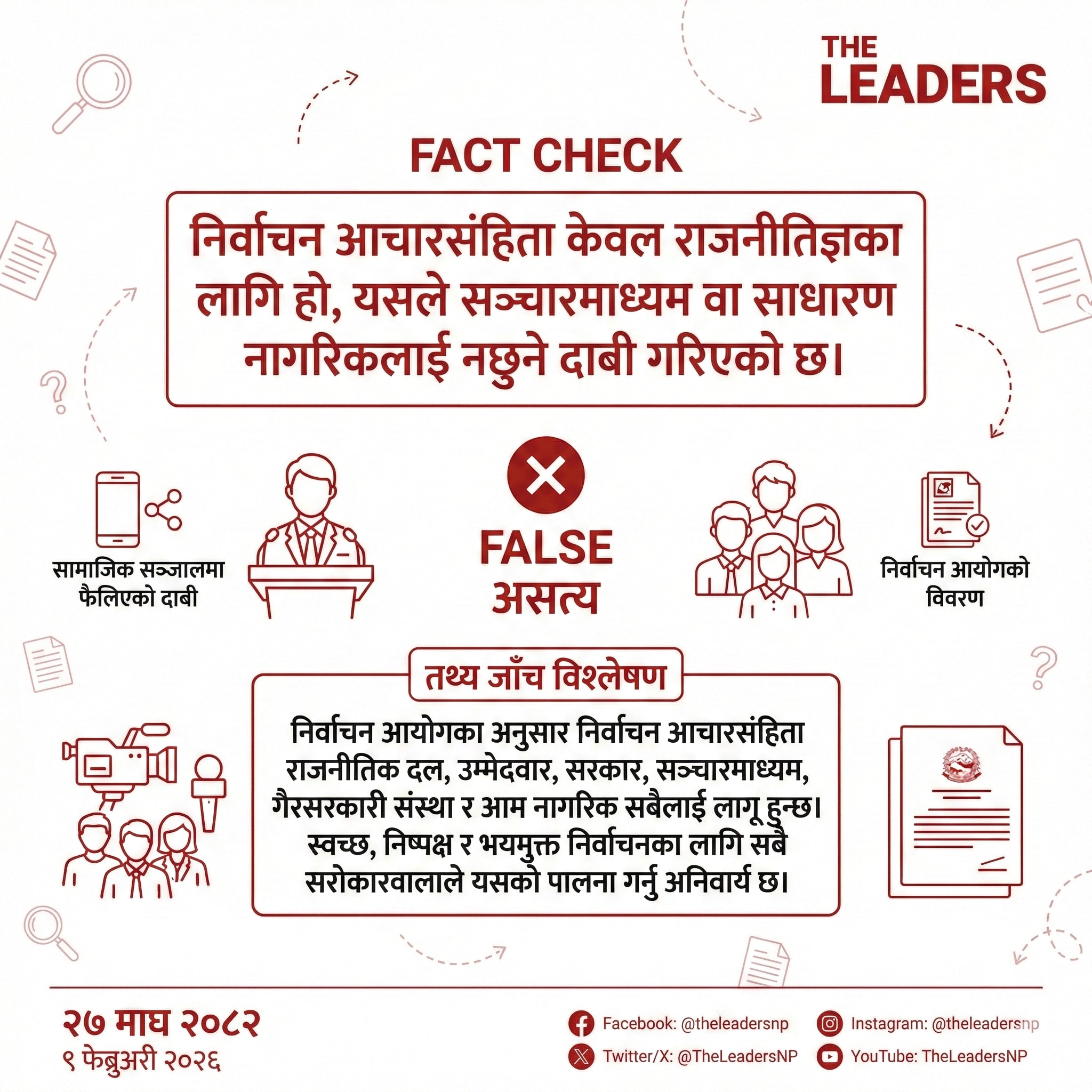
"The election code of conduct applies only to politicians and does not cover media or ordinary citizens."
This dossier summarizes the strongest available evidence and weighs competing claims.
Official Analysis
Official documents and public briefings from the Election Commission make clear that the Election Code of Conduct 2082 has a broad scope. It applies not only to federal and provincial governments, ministers, political parties and candidates, but also to media organisations, journalists, NGOs, educational institutions and individual voters.
The code explicitly lists media houses and journalists among those required to comply, with obligations to avoid biased, defamatory or inflammatory coverage that could unfairly influence voters. It also states that voters themselves must not engage in activities such as spreading false information, intimidating others at polling stations or misusing social media to violate the code.
Therefore, claims that the code of conduct is limited to politicians are incorrect. While enforcement capacity and consistency can be debated, the legal framework clearly covers media and ordinary citizens as well.
Evidence Index
- Exhibit 1Election Commission Nepal
- Exhibit 2The Himalayan Times
- Exhibit 3Nepalnews English
- Exhibit 4Digital Rights Nepal