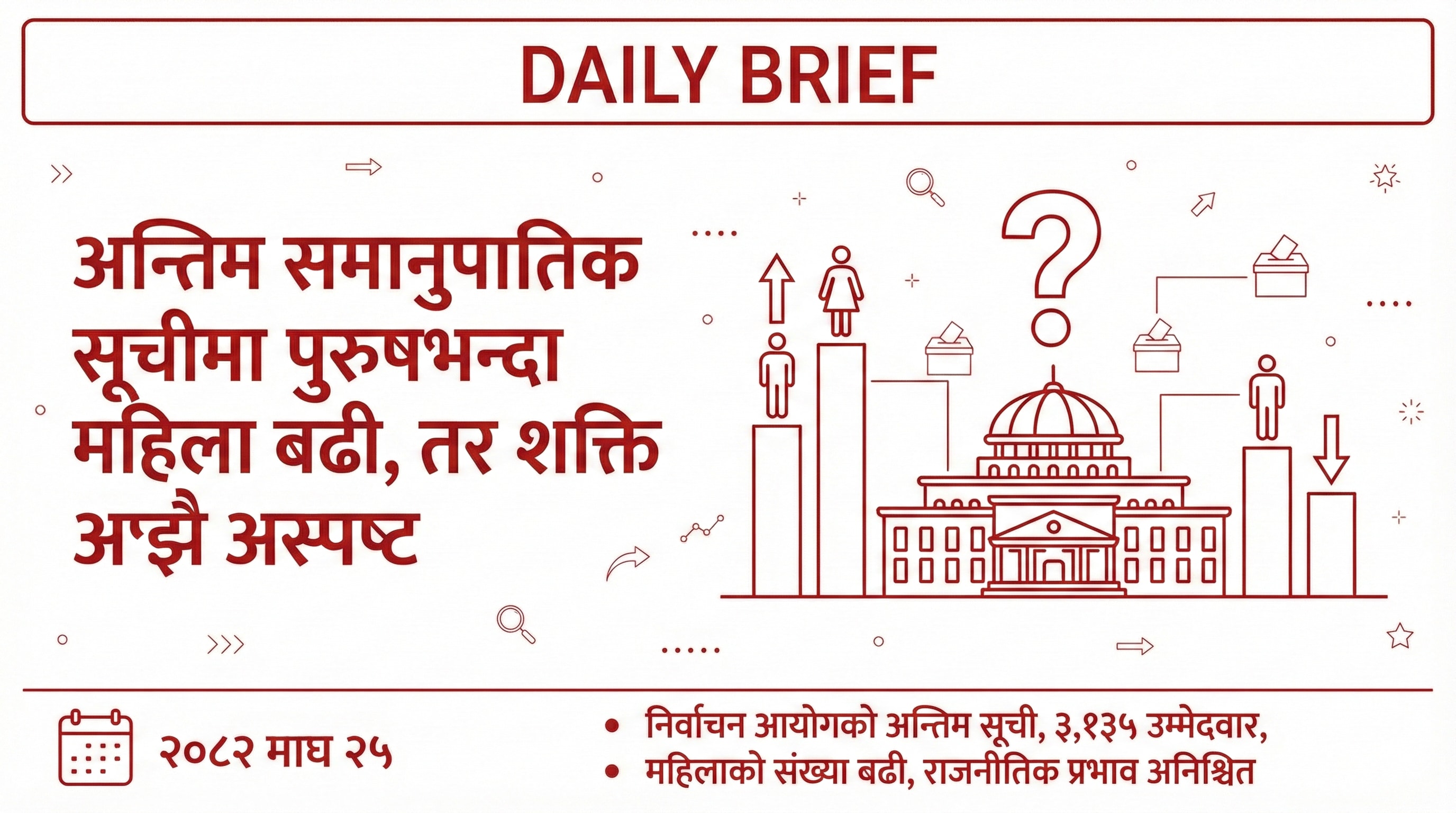
The Election Commission has published the final closed list of proportional representation (PR) candidates for the March 5 House of Representatives election, totalling 3,135 names from 63 political parties.
EC figures cited by Rising Nepal, Annapurna Express, Ujyaalo Nepal and other outlets show that women slightly outnumber men: around 1,772 women and 1,363 men feature on the final list. This reflects the constitutional requirement that women hold at least one‑third of seats in federal and provincial legislatures, though the law allows parties to meet that quota by combining first-past-the-post (FPTP) and PR results.
Advocates see the numbers as a rare case where formal rules have pushed parties to go beyond the minimum, at least at the list stage. Critics point out that voters do not choose individual PR candidates and that party leadership will still decide who ultimately takes seats once the final allocation is known.
The pattern also raises questions about where women are being placed within lists: are they clustered in symbolic positions or distributed across realistically winnable ranks? With many parties still dominated by male leadership, this PR milestone could either mark a step toward more substantive inclusion or remain largely cosmetic.
For voters, the key test will come after results: whether parties use their discretion to send women, Dalit, Madheshi, Janajati, disabled and other historically under‑represented candidates into parliament, or to protect existing power networks.