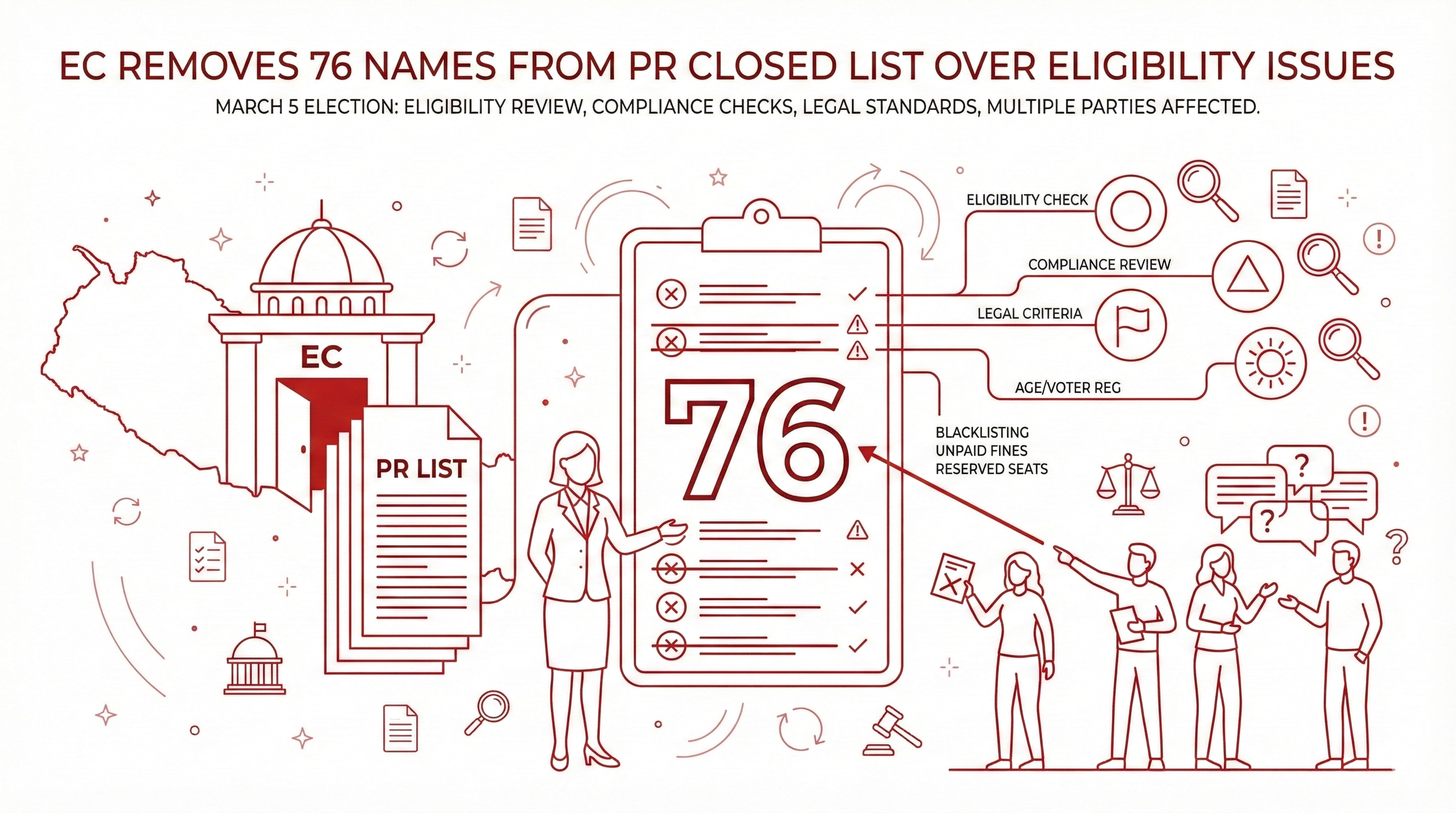
The Election Commission (EC) has removed 76 names from the political parties' proportional representation (PR) closed lists for the March 5 House of Representatives (HoR) election.
According to EC statements reported by state-owned and private outlets, the removals followed a review of complaints, legal provisions on candidate qualifications and information shared by other state bodies. Among those struck off are individuals blacklisted by the Credit Information Center, people who appeared simultaneously on Provincial Assembly PR lists, and candidates who had not cleared legally prescribed fines.
The EC has also removed a small number of names after parties themselves requested changes, and at least one candidate whose listing did not match voter registration requirements for a designated backward region. The Commission says this is part of routine legal scrutiny rather than a political purge.
This pruning comes on top of the Commission's publication of the final PR list, which still includes 3,135 candidates across 63 parties and 57 election symbols. For voters, the episode highlights how much of the inclusion or exclusion battle happens inside closed lists and legal vetting, long before ballots are printed.
The decision raises questions about how carefully parties checked their own nominees, why individuals with unresolved financial and legal issues were placed on lists in the first place, and whether smaller or newer parties have the same capacity as major forces to navigate complex compliance rules.