
New reporting from Sunsari district shows how far parties still have to go in promoting women under the direct first-past-the-post (FPTP) system, even as the proportional representation (PR) lists are finalised.
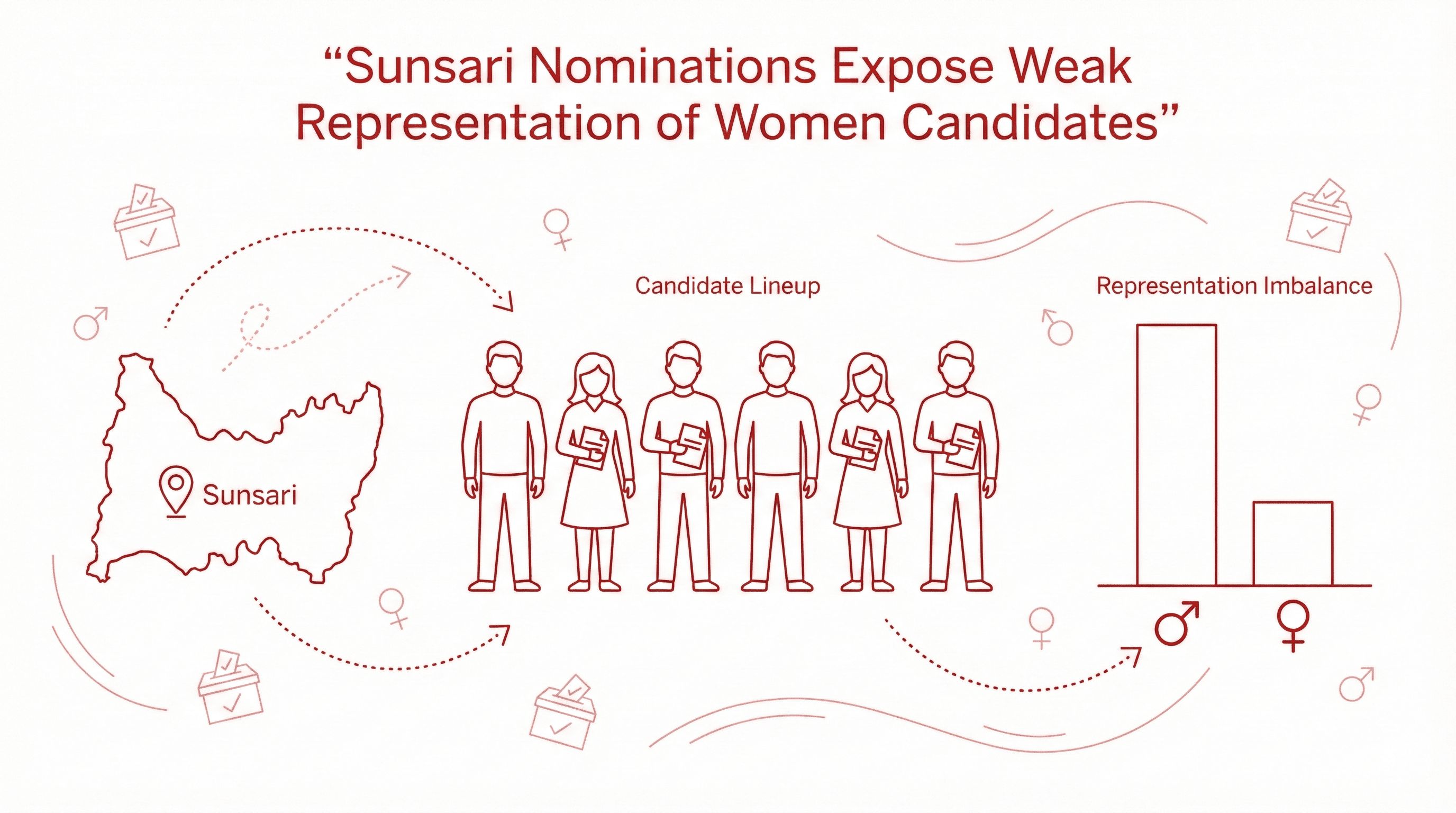
The Rising Nepal notes that across Sunsari's four constituencies, only 19 of 108 registered candidates are women, roughly 17 percent. Among the major parties, the Nepali Congress has not fielded any woman candidates in the district, while the CPN-UML, Rastriya Swatantra Party, Janata Samajwadi Party Nepal and the Nepal Communist Party have each nominated just one woman.
Constituency-level figures underline the pattern: in Sunsari-1, only two of 26 candidates are women; in Sunsari-2 and Sunsari-3, women account for about a quarter of candidates; and in Sunsari-4, five of 34 candidates are women. Meanwhile, several senior male leaders from across the political spectrum are running in these constituencies.
The Constitution requires that at least one-third of the total federal parliament be women when FPTP and PR seats are combined. However, as women's rights advocates have long argued, fulfilling the quota mainly through PR lists can still leave women underrepresented in the more visible and locally accountable direct seats. For voters in Sunsari, the ballot paper itself reveals where parties have chosen to invest their strongest backing.