
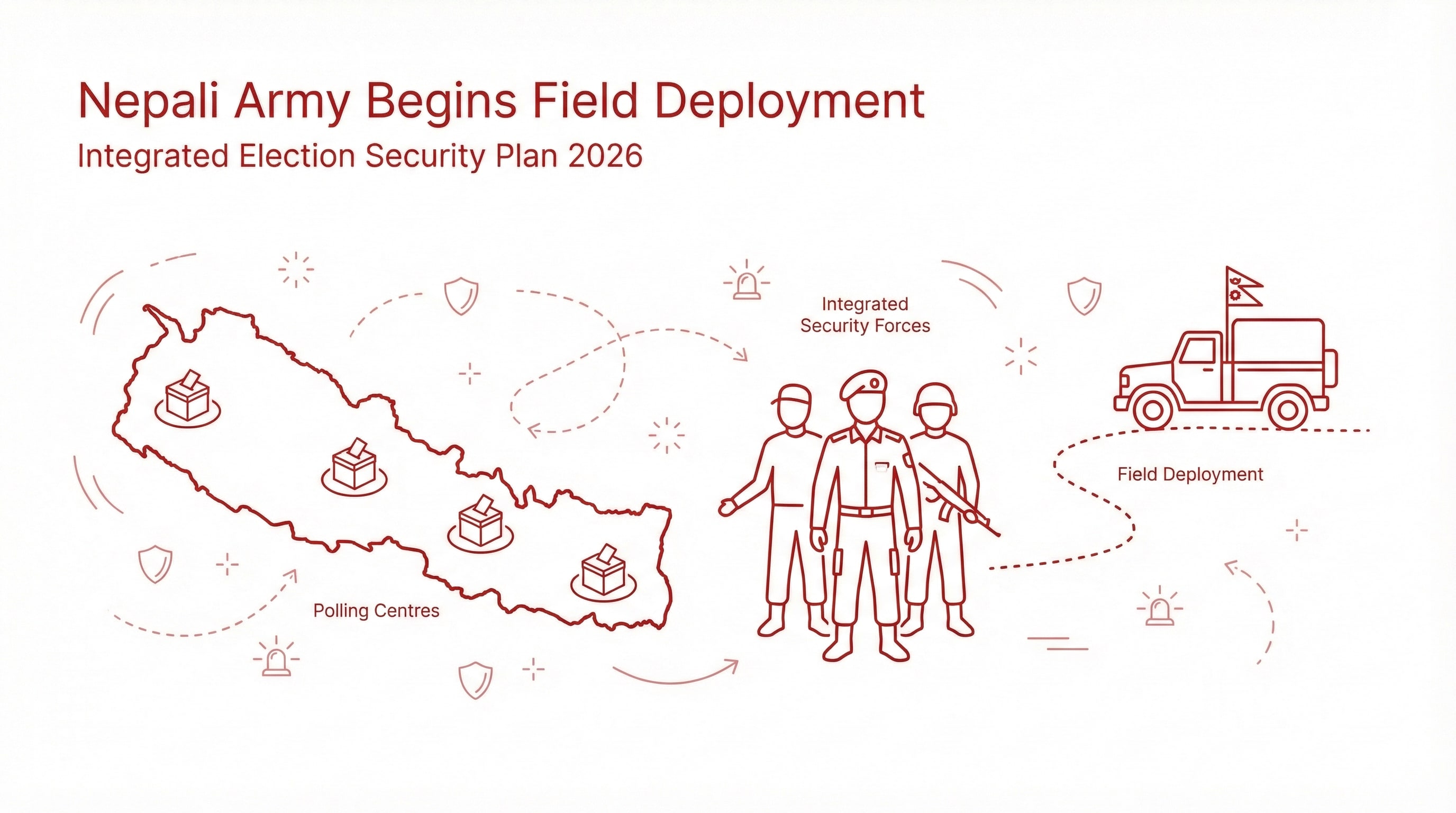
Security preparations for the March 5 House of Representatives election have moved into a visible phase, with the Nepali Army now deployed in the field across the country.
Reporting by The Rising Nepal, echoed in explainer pieces from NepalNews and other outlets, notes that 79,727 army personnel are being mobilised as part of an Integrated Election Security Plan approved in November 2025. In total, roughly 338,000 security personnel from the Nepali Army, Nepal Police, Armed Police Force, National Investigation Department and temporary election police will be deployed before and during polling.
Under the layered security model, Nepal Police and election police will guard polling stations, the Armed Police Force will form the second ring, and the Nepali Army will constitute the third ring. Army responsibilities include patrolling around polling centres, protecting strategic sites such as airports, banks and prisons, and securing the residences of key political figures. Election police constables have already received appointment letters and are undergoing training before field deployment.
The government has framed this build-up as necessary in light of the Gen Z protests of September 2025, which involved attacks on police posts and the looting of weapons. For many voters, the heavy presence of armed personnel could enhance feelings of safety. Others may worry that such a militarised environment near polling centres could be intimidating or even misused if security agencies appear to favour or target particular groups.