Background
Nepal's March 5 House of Representatives election is the first general poll shaped entirely under the post‑Gen‑Z protest political order. Early elections were called after street mobilisations challenged not just one government but a longer pattern of unaccountable rule, closed party structures and elite deals.
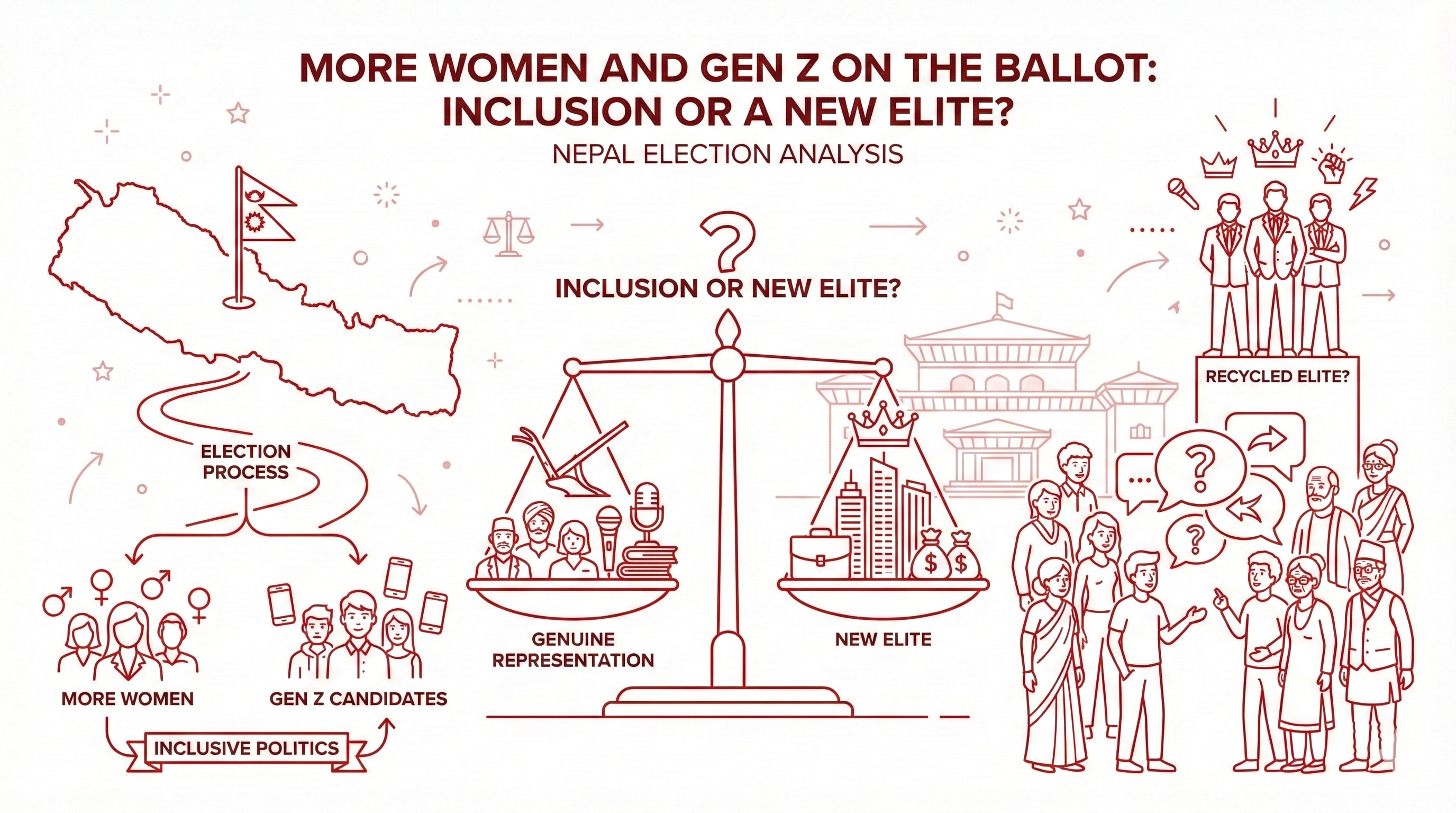
Against this backdrop, two numbers have captured attention. First, the final proportional representation (PR) closed list for the House of Representatives includes 3,135 candidates from 63 parties, with official Election Commission (EC) data indicating that women slightly outnumber men. Second, in Madhesh Province alone, more than 50 Gen‑Z candidates—many under 30—are contesting first‑past‑the‑post (FPTP) seats, a sharp break from past age profiles.
These figures look, at first glance, like a major step toward a more representative parliament. But representation is not just a headcount. It is also about who sets agendas inside parties, who gets to the winnable spots on lists, and whether voters see genuine alternatives or just new faces attached to old hierarchies.
What Has Changed
On the proportional side, EC statistics reported by multiple national dailies show roughly 1,772 women and 1,363 men on the final PR list. This means women are not just meeting the constitutional minimum of one‑third representation; they exceed it within the PR segment.
Part of this change reflects legal pressure. The Constitution of Nepal requires that at least 33 percent of federal and provincial lawmakers be women. In earlier elections, parties often used PR lists to "top up" female representation after FPTP results favoured male candidates. This time, the starting point is different: parties have pre‑loaded their PR lists with a majority of women from the outset.
At the same time, the EC has removed 76 names from those PR lists for failing to meet legal criteria, including blacklisting by the Credit Information Center, duplication on provincial lists and unpaid fines. That decision affected both male and female nominees and serves as a reminder that inclusion is filtered through a dense web of financial and legal rules that not all aspirants can navigate equally.
On the FPTP side, change is most visible in Madhesh. Reporting based on EC data suggests that 58 candidates there fall into the Gen‑Z age bracket, with 41 contesting as independents and 17 representing 12 political parties ranging from Janamat and Ujyalo Nepal to CPN‑UML and Rastriya Swatantra Party. Yet only two of these youth candidates are women.
Interviews with sociologists and campaigners highlight a shared frustration among young candidates with what they call "legacy" politics—top‑down decision‑making, opaque finances and weak accountability. Their candidacies are, in part, an attempt to carry the spirit of the streets into the legislature.
Taken together, these developments show real movement on two axes: more women on lists and more young people on ballots. But they also reveal persistent gaps—especially around gender in youth politics, and class and network barriers in PR nominations.
Why It Matters for 2026
For voters, these shifts matter on three levels.
First, at the symbolic level, seeing more women and young faces on ballot papers and party materials signals that formal institutions are not entirely closed. This is particularly important given that Nepal's final voter list now includes nearly 19 million citizens, with women and younger cohorts making up a growing share. If parliament looks nothing like this electorate, trust in the system erodes.
Second, at the structural level, PR lists are where parties can correct imbalances produced by FPTP competition. A PR slate in which women outnumber men creates the possibility—though not the guarantee—of a more gender‑balanced House even if many FPTP races remain male‑dominated. Similarly, the presence of youth candidates in contested constituencies tests whether voters are willing to privilege generational change over established names.
Third, at the power level, the key decisions are yet to come. Parties will retain discretion over which PR nominees ultimately take up seats once vote shares are known. They will also decide which youth candidates receive organisational and financial backing, and which are left to run as symbolic insurgents. Inclusion on paper can easily turn into exclusion in practice if these gatekeeping decisions follow old patterns.
There are also trade‑offs to consider. Pushing parties to nominate more women and youth can broaden representation, but it may also concentrate opportunities among those already close to power—relatives of senior leaders, urban professionals, or individuals with access to campaign finance. The risk is that new categories of inclusion reproduce older inequalities of class, caste and region.
Questions for Voters
All this places a set of uncomfortable but necessary questions before voters and parties alike.
- When you see a woman or young candidate on a ballot or list, what assumptions do you make about her or his independence from party elders and financiers?
- Do PR lists dominated by women translate into women with real influence over budgets, laws and oversight, or mainly into additional votes in party whips' hands?
- In constituencies where Gen‑Z candidates are running, are they being treated as serious contenders—with resources and protection—or as a way to capture a protest mood without changing how politics is done?
- How do factors like caste, class, language and geography intersect with gender and age in determining who actually gets close to power?
For The Leaders' readers, the challenge is not simply to applaud or dismiss the headline numbers. It is to look one step deeper: at the ordering of PR lists, the internal democracy of parties, and the concrete commitments youth and women candidates make on issues like employment, migration, federalism and social justice.
If the March 5 election delivers a House that is younger and more gender‑balanced on paper but still answers to the same narrow circles of influence, the promise of inclusion will ring hollow. If, however, voters use the new options to reward those who are willing to break with extractive habits—inside parties as well as across party lines—the 2026/2082 election could mark a quieter but more enduring turning point than any street protest.