From announcement to movement of materials
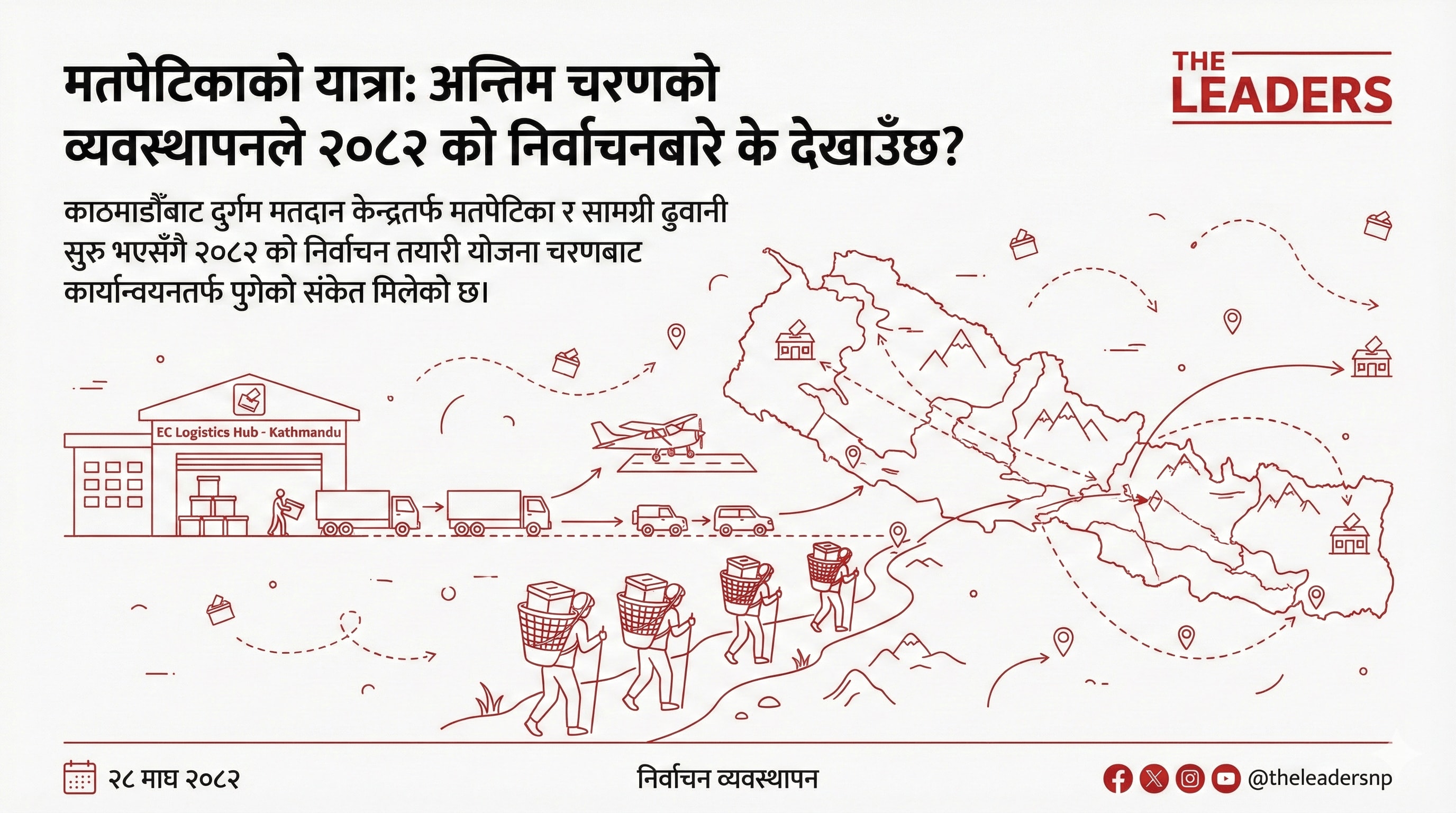
Ever since the interim government recommended, and the President announced, a fresh House of Representatives election for 5 March 2026, public debate has rightly focused on high politics: collapsing coalitions, new alliances and the Gen-Z protests that reshaped power in Kathmandu. Yet the quiet backbone of any election is logistical: ballot boxes, ballot papers, polling booths and staff who must be in the right place at the right time. The recent decision by the Election Commission of Nepal (ECN) to start dispatching ballot boxes to far-flung districts marks the transition from promise to practice. Packed, sealed and counted at the central warehouse in Kathmandu, these boxes are now travelling along highways, rough rural roads and, in some cases, by mule or porter to reach villages that appear on the map only as small dots.
Why logistics is a test of inclusion
In Nepal’s mixed electoral system, 165 members are elected from single-member constituencies and 110 through proportional representation. But in practice, those numbers mean little to a citizen whose polling centre opens late because ballot papers or boxes did not arrive on time. For voters in Karnali’s highlands or the mid-western hills, election-day access still depends on weather, roads and the state’s ability to deliver. Logistical performance thus becomes a test of inclusion. If some regions repeatedly experience broken seals, missing materials or last-minute relocations of polling centres, citizens there cannot be expected to feel the same ownership of the process as urban voters whose booths open smoothly at 7:00 a.m.
The EC’s preparation curve
The ECN has stated that more than 60 percent of overall preparations are complete, citing finalised directives, schedules and resource allocation. Earlier timelines indicated that polling locations would be gazetted, voter lists updated and security plans agreed with the Home Ministry and security agencies. Dispatch of ballot boxes and the acceleration of ballot paper printing are the visible tips of a much larger iceberg of planning. Behind each truck leaving Kathmandu lie thousands of micro-decisions: how many contingency boxes to send, how to route consignments to avoid landslide-prone sections, how to pair boxes with trained staff who understand handling protocols.
Risks in the final mile
It is in the final few kilometres of this journey that the risk of failure is highest. Past elections have seen complaints of boxes damaged in transit, ballots getting wet or lost, and confusion about which materials belong to which polling centre. In some locations, security escorts have been thin, raising concerns about tampering. This time, security agencies are planning joint operation centres and Myadi police deployments to accompany sensitive materials. But success will depend on implementation: whether instructions given in Kathmandu are understood and followed by officials in remote depots and checkpoints.
Transparency as a confidence tool
Logistics is not just a technical matter; it is also political, because people infer intent from performance. When ballot materials arrive late or damaged in one region but not another, rumours of deliberate bias spread quickly, especially in areas with histories of marginalisation. The ECN can mitigate this by publishing clear, accessible information: how many boxes and ballots are dispatched to which districts when; what contingency plans exist for weather or road closures; and what citizens should do if their polling centres do not open on time. Regular briefings in Nepali and local languages, and coordination with local media and civil society monitors, can convert a largely invisible logistical operation into a visible source of reassurance.
What success would look like on 5 March
If, on election day, polling centres across the country open broadly on schedule, queues move at a reasonable pace, and there are only isolated complaints of missing materials, much of the credit will belong to the unglamorous logistics chain now being put to the test. Such an outcome will not eliminate deeper political grievances or debates about alliances and candidates. But it will send a simple, powerful message: that the state is capable of organising a nationwide democratic exercise on time, even amid turbulence. In a year when institutional trust is under strain, that alone would be a significant achievement.