Background
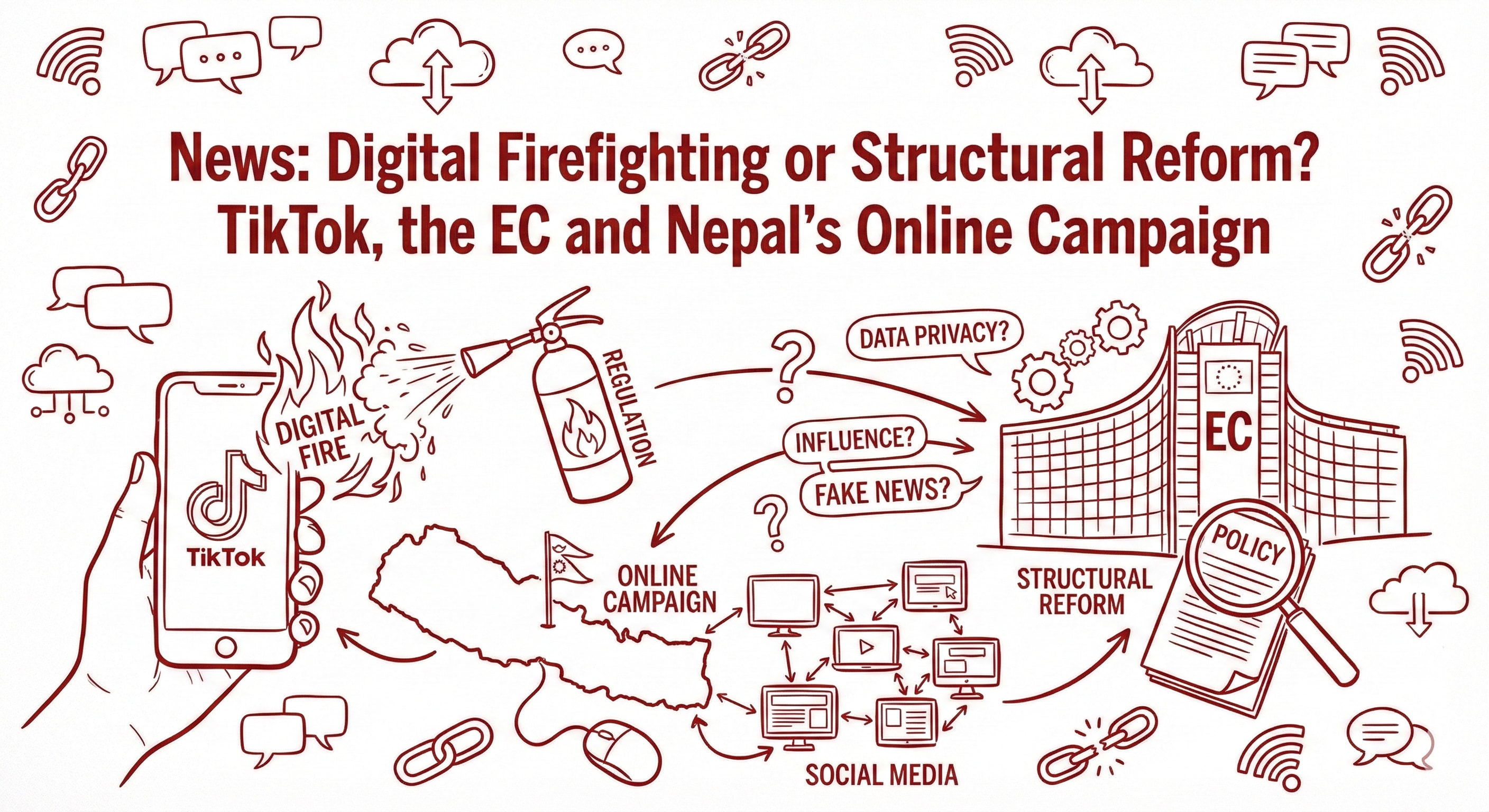
The 2025 Gen Z protests that toppled the K. P. Sharma Oli government were organised largely through phones, group chats and short videos. That experience left Nepal’s political class wary of the disruptive power of online mobilisation at the very moment that millions of young voters are consuming most of their news through social platforms. Against this backdrop, the Election Commission of Nepal (ECN) has enforced an unusually wide-ranging Election Code of Conduct, 2026 and, this week, signed a memorandum of understanding with TikTok to cooperate on election integrity for the 5 March House of Representatives polls. Reports in The Himalayan Times, The Rising Nepal, myRepublica and technology outlets describe a partnership in which TikTok offers free support to promote official information, remove harmful content and train EC staff on platform tools. For many, this looks like a pragmatic attempt to tame a chaotic information environment; for others, it raises hard questions about who gets to decide what counts as harmful speech in a polarised and traumatised political moment.
What Has Changed
Nepal’s new election code of conduct is far more explicit about digital behaviour than in previous cycles. As Digital Rights Nepal and Nepal News explain, the code bans false or misleading information, hate speech, character defamation and the use of deepfakes in campaigns. It also treats campaigning through fake accounts or anonymous groups as a violation and holds not only parties and candidates but also government officials, security personnel, media and voters responsible for their conduct online. This is a broad assertion of regulatory power at a time when spontaneous, meme-driven content is central to youth political expression.
The TikTok–ECN memorandum takes this a step further. Instead of simply issuing warnings, the commission now has a formal channel to flag potentially violative content directly to the platform, and TikTok has committed to amplify ECN’s educational materials and clarify its own rules on misinformation and political content. Separate reports mention a capacity-building 'election integrity workshop' for EC officials, aimed at explaining TikTok’s policies and reporting mechanisms. Compared with the blanket ban that Nepal briefly imposed on TikTok in the past, this looks like a more targeted and cooperative approach. But it also moves much of the decision-making about visibility and moderation into a semi-opaque space shared between an unelected constitutional body and a foreign technology firm.
Competing Perspectives
From one perspective, this partnership is overdue. The same digital tools that helped expose corruption and coordinate the Gen Z protests also make it easy to fabricate clips, spread ethnic slurs or organise targeted harassment at scale. Election officials, still working on paper voter rolls in many districts, fear being overwhelmed by waves of synthetic content they barely understand. For them, credibility depends on being seen to act; a visible MoU with a major platform signals that the commission takes digital threats seriously, just as its integrated security plan signals seriousness about physical threats.
Civil liberties and digital rights advocates see a different risk. They note that the code of conduct allows the ECN to fine offenders and even cancel candidacies for serious violations, and worry that vague concepts like 'misleading' or 'harmful' information can be stretched to cover satire, investigative journalism or harsh but legitimate criticism. If TikTok removes posts based on ECN referrals without publishing detailed transparency reports, users may find their content disappearing with no clear explanation and no effective appeal. In a political context where trust in institutions was badly damaged by the 2025 crackdown, any perception that online spaces are being selectively policed could deepen rather than heal the legitimacy crisis.
There is also a generational dimension. Platforms like TikTok are disproportionately used by younger Nepalis, including many first-time voters with limited attachment to older parties. For them, funny or angry short videos are not just entertainment but a way of doing politics. If the combination of strict rules and platform enforcement chills that expression more heavily than it constrains traditional rallies, wall posters and mainstream television, then regulatory action may unintentionally tilt the playing field back towards older, better-resourced actors.
Why It Matters for 2026
The March 5 election is the first general vote after the state’s violent confrontation with its own youth. The election code of conduct and the TikTok MoU are both officially framed as tools to ensure 'free, fair and fear-free' elections, but their impact will be judged by how they shape three specific issues: trust, inclusion and accountability. On trust, a visible response to misinformation could reassure voters that outrageous rumours and deepfakes will not go entirely unchecked. Yet if enforcement appears partisan or opaque, it may reinforce suspicions that institutions are more interested in managing narratives than in confronting underlying grievances about corruption and inequality.
On inclusion, the key question is who gets protected and who gets silenced. Marginalised communities often face online hate campaigns that can spill over into real-world violence; effective moderation, designed in consultation with those groups, can make it safer for them to participate. At the same time, loosely defined bans on 'negative' content can dissuade victims of abuse or discrimination from speaking out, especially if they lack legal support. The line between protecting dignity and suppressing uncomfortable truths is thin, and the ECN’s choices in high-profile cases will set powerful precedents.
On accountability, the new regime places strong expectations on platforms and regulators but relatively few on transparency. Voters currently have limited ways to know how many posts are being taken down, on what grounds and at whose request. Nor is it clear how much independent oversight exists over ECN’s own decisions under the code of conduct. Without routine publication of anonymised takedown statistics and clear documentation of legal reasoning, the system risks functioning as 'digital firefighting' – reactive, case-by-case damage control – rather than as a predictable framework of rules that citizens can understand and debate.
Questions for Voters
For Nepali voters, especially those active online, the new digital rules invite a series of uncomfortable but necessary questions. When sharing or creating political content, how confident are you that you understand the boundaries of the election code of conduct, and are those boundaries fair? Do you feel safer knowing that platforms like TikTok are coordinating closely with the Election Commission, or does that closeness make you worry about overreach or censorship? If a video criticising a powerful figure disappears, will you assume that it was abusive or that it struck a nerve?
More broadly, what kind of digital public square do citizens want after March 5 – one that is tightly patrolled for the sake of stability, or one that tolerates more noise and risk in exchange for wider space to organise and dissent? There is no simple answer, and different communities will answer differently depending on their experiences of both state violence and online abuse. The ECN–TikTok partnership, together with Nepal’s ambitious code of conduct, has created a new infrastructure for policing online speech. Whether that infrastructure ultimately strengthens or weakens democratic accountability will depend not only on the commission and the platforms, but also on how actively voters, journalists, lawyers and civil society demand transparency and push back against unfair applications of the rules.