Background
Over the past decade, Nepal's elections have moved steadily online. Parties launch slogans and manifestos on Facebook before they appear on wall posters. Candidates livestream village visits and quickly edit clips to circulate on TikTok. Supporters and opponents wage fierce battles in comment sections and closed messaging groups long after rallies end. By 2022, concerns about online hate speech, disinformation and deepfakes were already visible, but regulatory tools were limited and enforcement patchy.
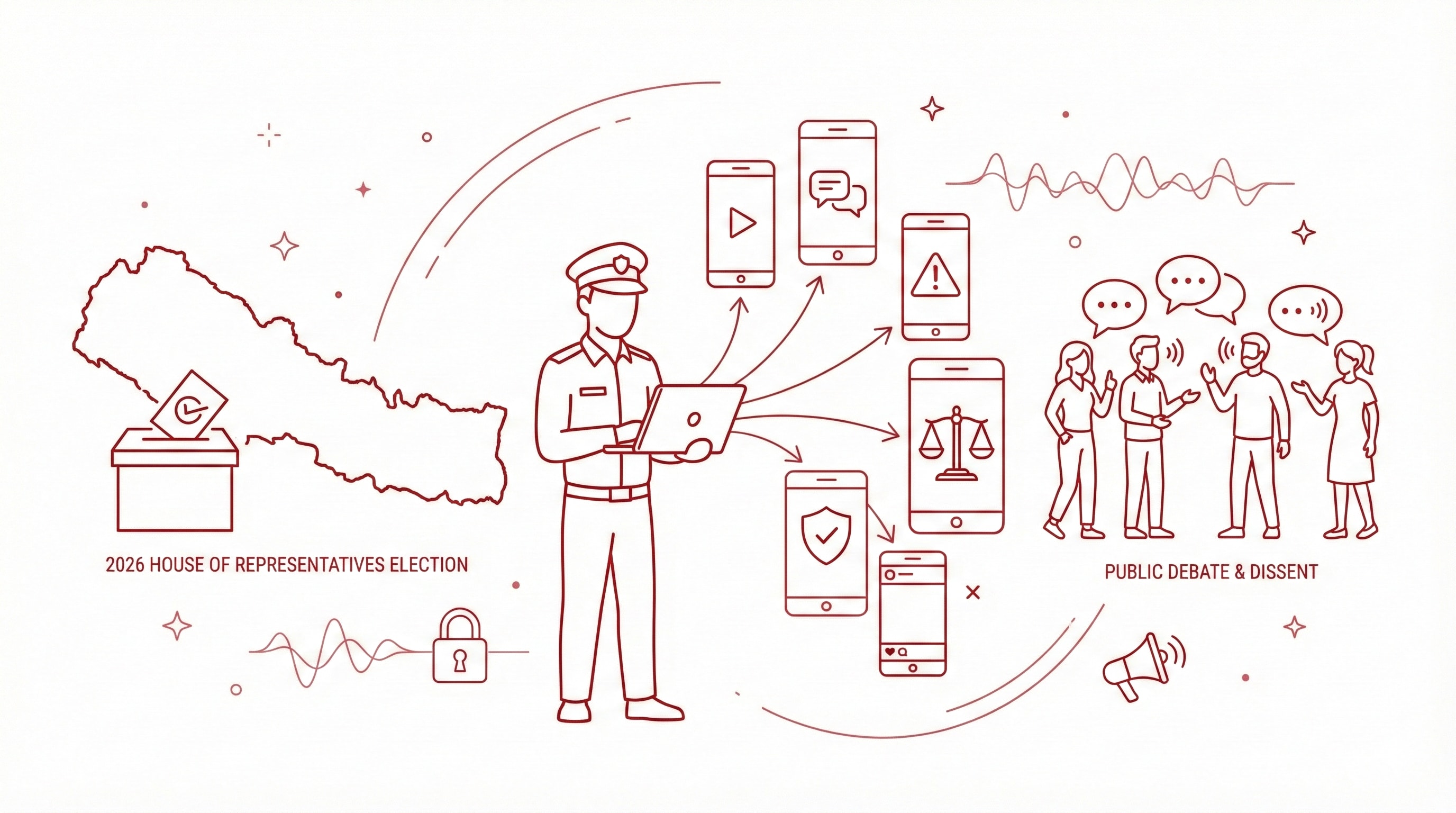
For the 2026 House of Representatives election, the Election Commission of Nepal (ECN) has tried to move ahead of the curve. It has approved a new Election Code of Conduct, 2082 and reinforced earlier social media and information policies. These documents prohibit operating fake accounts to influence elections, spreading false or divisive content, misusing artificial intelligence to manipulate audio or video, and using public institutions or staff to conduct digital campaigning.
At the same time, civil society organisations and digital rights groups note that an election is also a rare moment when citizens feel empowered to speak, criticise and demand accountability. The tension between control and openness is now playing out in very public ways.
What Has Changed
Compared with earlier electoral cycles, three changes stand out.
First, the scope of the code of conduct has expanded. Past rules focused mainly on traditional media and physical campaigning. The 2082 code, along with ECN's social media policy, explicitly covers content that is posted, reposted, commented on, livestreamed or amplified with or without the use of artificial intelligence. It treats not only the creation of harmful content but also deliberate engagement with such content as a potential violation when done with the intention of influencing the election.
Second, enforcement has become more visible. The EC has issued clarification notices to dozens of individuals and organisations, many of them linked to online behaviour. High-profile cases include the repeated summoning of Rastriya Swatantra Party candidate Balendra Shah over his social media comments and alleged use of plainclothes police in campaign videos, as well as actions against candidates accused of publishing inflammatory statements about religion, identity or national symbols. These moves signal that the EC is willing to act on digital evidence and social media complaints, not just on physical incidents.
Third, other institutions have entered the conversation. The National Human Rights Commission has warned about misuse of digital technology to record secret ballots and invade voter privacy, while the government's Central Security Committee has instructed district bodies to step up social media monitoring as part of the broader election security plan. Telecommunications regulators and internet service providers are being asked to cooperate in tracing and, if necessary, restricting harmful content.
The Promise and the Risks
Supporters of strict rules argue that without them, the election could easily be distorted. Deepfake videos, fabricated quotes or targeted hate campaigns can spread far faster than traditional corrections, especially in languages and dialects that global platforms are slow to moderate. In a polarised environment, rumours about rigged ballot boxes or secret deals can discourage turnout or trigger unrest. From this vantage point, the code of conduct and social media policy are tools to protect the integrity of the process and the safety of vulnerable groups.
Yet, the same tools can also be used in ways that narrow democratic space. The line between discourteous criticism and 'undignified' language, or between sharp satire and 'character assassination', is not always clear. If citizens fear that a harsh meme about a powerful leader could be interpreted as a code violation, they may choose silence over expression. Journalists and activists who investigate the behaviour of security forces or ruling parties online might feel pressure to soften their reporting.
Selective enforcement is another concern. While the EC has taken action against individuals from multiple parties, public perception often hinges on which cases are highlighted, how quickly they proceed, and whether sanctions are applied evenly. If smaller or newer parties see themselves being scrutinised more intensively than established forces, they may view digital regulation less as a shield against abuse and more as a tool of control.
Voters, Parties and Platforms
Different actors experience the new rules in different ways.
For voters, especially young and first-time voters who consume most of their political information online, stricter rules can be both a filter and a barrier. On one hand, clear prohibitions against deepfakes, hate speech and fabricated polls can make it easier to dismiss obviously manipulative content. On the other hand, if platforms or authorities overreact by taking down legitimate pages or limiting political content broadly, voters may lose access to alternative viewpoints and grassroots voices.
For political parties and candidates, the code forces a rethinking of digital strategy. Campaign teams must invest more in compliance and documentation: keeping records of who manages pages, how content is produced, and how complaints are addressed. Smaller parties that relied on edgy online branding or volunteer-run pages face pressure to professionalise quickly, while large parties with legal teams may adapt more easily. Parties that are serious about internal democracy may also need to reconsider how they use closed groups and messaging channels in internal contests, so that money, pressure and misleading claims do not simply shift from public feeds into semi-private spaces.
Global and local platforms occupy an awkward position. Many have community standards against hate speech and disinformation, but their enforcement in Nepali languages is uneven. They can receive takedown requests from state bodies, parties or activists that are themselves politically motivated. Without transparent reporting, users cannot easily tell whether content disappeared because it violated community standards, broke election law, or simply offended a powerful actor.
Questions for Voters
For readers who want to navigate this environment thoughtfully, a few questions may be useful:
- When reading political content online, is it clear who is speaking, or does the account hide its identity while pushing strong claims?
- Does a piece of content provide evidence and context, or does it mainly provoke anger or fear with little verification?
- When someone is fact-checked or asked for clarification by the EC, do we automatically see them as a victim or a villain, or do we wait to see the details and the EC's reasoning?
- Are we holding our preferred parties to the same standards of online conduct that we demand from their rivals?
The new digital rules for the 2026 election will not resolve the deeper tensions between free expression, accountability and protection from harm. They are, however, a first serious attempt by Nepali institutions to grapple with the realities of an algorithm-driven campaign. Whether they end up expanding or shrinking democratic space will depend less on the text of the code and more on how consistently, transparently and self-critically it is enforced.
In the end, no commission or platform can fully 'police' the digital campaign. Voters themselves remain the final filter. The more they question what they see and share, the harder it becomes for any actor, old or new, to win power by distorting reality rather than engaging with it.