Alliance politics in a fragmented field
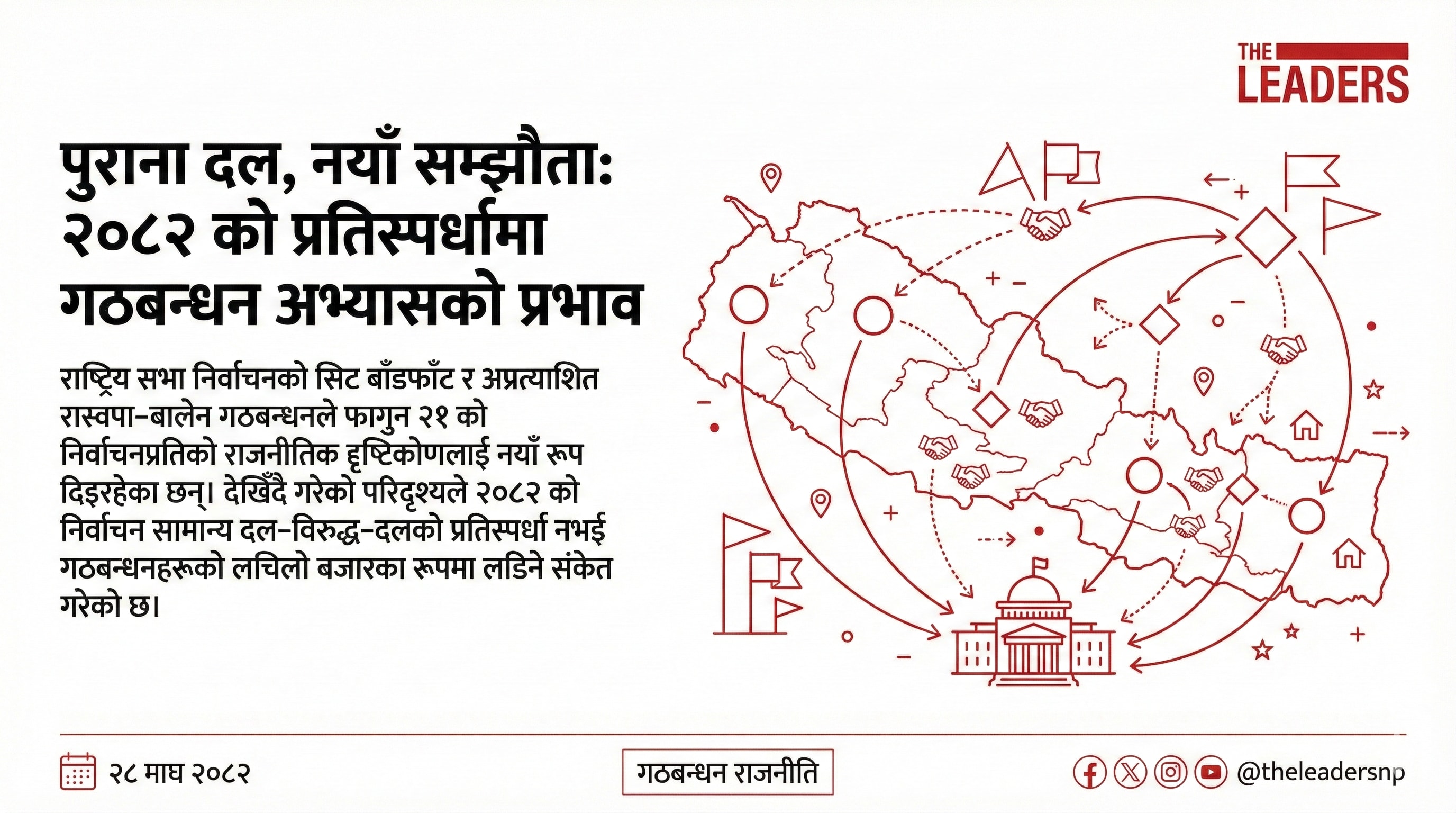
Nepal heads into the 2026 election with an unusually crowded party system: more than fifty parties registered to contest, ranging from long-established national forces to small, regionally rooted platforms. In such a landscape, alliances are less a choice than a necessity for players hoping to convert vote shares into seats. The seat-sharing negotiations for the January National Assembly election offered a preview. Nepali Congress, CPN-UML and a new left front carved up upper house seats through careful bargaining, while Madhes-based parties weighed the trade-offs between joining larger blocs and preserving their distinct identities.
The RSP–Balen shock to the system
Into this already complex picture arrived the Rastriya Swatantra Party–Balendra Shah partnership. It is striking not only because of its personalities—a TV anchor-turned-politician and a rapper-engineer-turned-mayor—but because it disrupts the familiar pattern of alliances being stitched solely among legacy parties. By projecting Shah as a future prime minister while keeping RSP’s organisational structure intact, the alliance attempts to fuse anti-establishment energy with institutional machinery. For disillusioned urban voters and the youth who led protests against corruption and misgovernance, this can appear as a more credible vessel for change than simply rotating older faces in and out of government.
What traditional parties are learning
The big parties have taken note. Their own experiments in the National Assembly polls show a growing willingness to join hands even with rivals when arithmetic demands it. For them, 2026 is about minimising fragmentation within their ideological families so that new entrants do not benefit from divided votes. At the same time, overreliance on top-down alliance formulas risks alienating local cadres and voters who feel sidelined in ticket distribution. If party workers perceive deals as elite bargains that sacrifice local leaders for short-term gains, disaffection can dampen mobilisation on polling day.
Voter choice and accountability
From the citizen’s standpoint, alliances can make politics both simpler and more confusing. On one hand, clearer blocs can offer more distinct options: a conservative front, a left alliance, a reformist or anti-establishment pole. On the other, when long-time rivals suddenly campaign together, it becomes harder to ascribe responsibility for past policies and failures. This is particularly true in Nepal’s proportional list, where backroom negotiations often determine ranking and, therefore, who enters parliament. Without transparent criteria, alliances may reinforce closed-door politics even as they promise efficiency.
The post-election coalition game
Whatever the precise seat outcomes on March 5, coalition-building will almost certainly be required to form a government. Alliance behaviour before the vote will heavily shape what citizens consider legitimate after it. If voters feel they were clearly informed about who was likely to team up with whom, post-election coalitions will be easier to accept. But if parties campaign on starkly different platforms and then rapidly realign without explanation, it will deepen cynicism and fuel the narrative that "all politicians are the same".
What to watch in the coming weeks
In the weeks ahead, three alliance dynamics bear close watching: whether the Congress–UML–left front cooperation in the upper house produces a template for the lower house; how far the RSP–Balen alliance can expand beyond its urban base; and whether Madhes-based and identity-focused parties opt for broader coalitions or remain stand-alone players. These choices will not only decide who governs after 2026, but also whether Nepal’s party system moves towards greater coherence or slides further into fragmentation tempered only by opportunistic deals.